Showing posts with label Business. Show all posts

Sunday, November 04, 2007

Heads you win, tails I lose - the City explained

Imagine your job is taking huge gambles with other people's savings and pensions. Imagine also that the bets are arranged so that you are paid a fortune when things turn out well, but you don't lose anything much when they go wrong. How would you behave...?

I think you might rapidly develop a hog's appetite for wild risk taking. And that is, in essence, what is wrong about the financial markets - the incentives of individual traders and managers are not aligned with the interests of those whose money they manage. The pay system based on big bonuses creates a sharp asymmetry in rewards for success and penalties for loss. There are no negative bonuses that penalise big losses. The worst that can happen is a few months gardening and a pay-off that would dwarf most people's regular pay. The institution, its shareholder or investors take the pain - not the trader or manager.

... continues. Read full post.

Tuesday, July 24, 2007

Emissions trading - notes on a scandal

Another day, another broadside against carbon emissions trading. The FT's Martin Wolf offers advice to the new Chancellor, including:

While simplifying tax, he should also take a close look at green taxation. Simple taxes that apply across-the-board are what is needed. The grant of valuable rights to big polluters through systems known as “cap-and-trade” is a scandal. [here]

This is an increasing theme, with even American giants like Alan Greenspan and Paul Volker coming out against cap 'n' trade and in favour of a carbon tax [see article]. I have to say I'm ever more swayed by this view, see my posting To Cap or to Tax.

But is the EU system 'a scandal', as Martin Wolf says? You can certainly make the case - the permits are given away to businesses, but they are valuable because they are scarce 'property rights' - the right to use the atmospheric sink for carbon. It's hard to put an exact value on these permits - see charts of the market price for EU allowances from Point Carbon showing the collapse of price in 2007 but a steady price of about €20 so far for the future price of 2008 EUAs... but in total they are worth a great deal.

€billions for what purpose?
So if, say, €20/tCO2 is used to give an illustrative value of the ETS price, the value of the rights to emit over 200MtCO2 to UK industry comes to over €4.3 billion. To the power sector alone, it comes to €2.7 billion (see numbers in this Google spreadsheet based on 2005-06 ETS results [XLS]. The power sector is especially annoying because it actually passes these costs on to the consumer, even though it doesn't actually pay for the permits, which are mostly given away in the EU system. They have adopted this as an accounting convention, reflecting the opportunity cost of holding the allowance for each unit of electricity sold. They can pull this trick off because they are an oligopoly and don't face competition from producers outside the system. So even allowing for the permits that they have to buy because they are given fewer allowances than they need, the power companies profit from this by €1.8 billion... and the bigger and dirtier they are, the more they make, because allowances are given to them in proportion to their historic emissions! What exactly is the public purpose served by transferring billions from energy consumers to energy company shareholders in approximate proportion to how polluting they are? Is that a scandal? Well you could defend it by saying that it was necessary to get the system off the ground - an argument that works if and only if the system is changed as soon as possible. Alternatively, you could see it as gullible fearful governments and bureaucrats being outsmarted at every turn with the poor public bearing the cost for nothing.

What to do?
This does in fact partially implement the polluter pays principle, in that the consumer is effectively 'taxed' for their pollution through this system because the permit costs are passed on. It's just that the 'tax' revenue goes to the companies not the government - and therefore the scope to do something useful with €4+ billion in the UK is lost. The answer is to auction the permits so that the government gets the revenue. The international competition arguments against making them buy their right to pollute are mostly hogwash and really apply only with force where the industry is energy intensive and highly traded internationally. Excellent analysis by Grubb & Neuhoff summarised by the Carbon Trust, [here] suggest that competitiveness is a minor concern and only aluminium should be a worry. There should be no question of violating the polluter pays principle, options include ideally reaching international sectoral agreements through the Kyoto Protocol or tax adjustments at borders to correct for ETS costs for trade across EU borders.

A novel approach for aviation in the ETS...
My suggestion is to bring as much EU aviation as possible into the system but give the sector no initial allowances at all. This would mean it would have to buy CDM credits or allowances from other emitters in the EU system. This has the equivalent effect of making 'carbon offsetting' mandatory for all flights. It's economically equivalent to taxing aviation and spending the proceeds on reducing emissions in developing countries.

This lot needs to be agreed in time for the third phase of the EU ETS - which starts after 2012, but is under discussion now.
... continues. Read full post.

Sunday, July 01, 2007

England goes smoke-free - wider lessons

Long awaited 1st of July arrives, and most enclosed workplaces (including pubs and restaurants) in England will go smoke-free today [BBC]. It's a triumph for all involved - both campaigners and government insiders - following a sustained struggle. It's also a vital next step in dragging down smoking rates - see chart based on ONS and Tobacco Advisory Council data care of Cancer Research UK, [XLS]. Still at about 25%, that's a huge number of people using an addictive product that kills one in two long term users - and does a lot of damage before death.

The ban on smoking in public places has always been justified around protecting non-smoking workers, for which there is the strongest civil liberties and legal basis, but its biggest public health benefit will come from 'denormalising' smoking - removing the societal support for smoking as a normal activity and role-modelling effects - and raising the cost of smoking in terms of time and hassle. The effect should be an acceleration in quitting and fewer starting.

... continues. Read full post.

Sunday, April 29, 2007

Mass killing machine making lots of money

Hopes that Big Tobacco might be in retreat are looking pretty forlorn. I came across BAT's share price data showing a huge gain over the last seven years, including a sharp and sustained rise following agreement of the WHO Framework Convention on Tobacco Control (FCTC) - an attempt by 146 governments (so far) to establish a common approach to regulating this industry and pushing a public health agenda. The FCTC text cover advertising, product labelling, smuggling, smoke-free environments, taxation and so on - much more useful information at the Framework Convention Alliance.

I remember having lunch with an analyst from one of the City of London investment banks in 2000, and asking why he had such a strong 'buy' recommendation on the BAT stock when there was so much litigation and regulation in the air. He replied "it's in the fundamentals: they sell so much of this stuff, it's really profitable, their customers are addicted, and worldwide the only way the pack price and customer base are heading is upwards".

The massive increase in BAT's stock price arises from gradual move to a valuation that reflects those fundamentals - the price was heavily discounted before. Investors now believe that the risks of damaging litigation are falling and that the FCTC wont slow the spread of tobacco use in developing countries - especially to women. Smoking kills about 5 million per year (and rising fast) worldwide, there are about 1.3 billion users, also increasing. On current trends about 1 billion will die early from tobacco use in the 21st Century - it is amongst the worst and most avoidable of public health problems.

I still find it incredible that many public health professionals can look at this situation and conclude there is no place for a market-based strategy aiming to switch as many tobacco users as possible from smoking cigarettes to using smokeless tobacco in its many forms (with much lower risk than smoking)... In fact, many in public health are determined to block attempts to make the market for smokeless tobacco products take off. Yet we know this has yielded large public health gains in at least one country, Sweden [research] and there is a strong case in consumer rights to be able to choose products that are vastly less hazardous, especially when you are addicted. Lynn Kozlowsky [here] invites us to imagine we were trying to help someone in our own family - would we really try to stop them trying something 100 times less hazardous? There's a compelling body of evidence supporting this strategy [eg. see International Harm Reduction Association library] and arguments have raged for years without the opponents of this approach ever once making a convincing case, or even any case. The truth is that they don't like the idea of tobacco companies making money or conceding there is any place for a tobacco product as part of the solution.

But make money they will, and lots of it. I'm all for banning smoking in public places and stopping the advertising etc - that can only help. But one of the big public health questions of the 21st Century is whether Big Tobacco can be manoeuvred into making money by selling smokeless tobacco products instead of cigarettes, which are perhaps around 100 times as hazardous. One danger is that fussy, insular and instinctively authoritarian public health people will continue down the evidence-free path of blocking these developments and insist that for smokers it has to be 'quit or die'. On the other hand, and more positively, tobacco companies may see smokeless products as a way of doing business with less death and disease and persuade regulators that they needs some regulatory tweaks to make it work - for example it is still impossible to tell smokers the truth about relative risks, and much public effort go in to obscuring it. In Europe, the much safer products are banned, while cigarettes are on open sale. It would be a pity if public health people continued to get in the way - that's the real scandal.
... continues. Read full post.

Saturday, April 21, 2007

Atrocity exhibition

There is something stunning in the brilliance of Google Earth [download] - a streaming map of the world in the form of satellite photography with the mean to zoom from planet to street level in scale. 'Layers' are overlaid on the map images showing an ever expanding range of surface features: national boundaries, roads, video stores, government offices, monuments - with 3D buildings, flights through the Grand Canyon etc. Each year the images increase in resolution and the coverage of higher resolution photography increases.

But potentially interesting political uses are also emerging: take the pictured map of conflict in Darfur... The recently announced (CNN / BBC) layer by the United States Holocaust Memorial Museum documenting atrocities in Darfur (an image grab shown to the left) is a pivotal development that would have been impossible just five years ago. When actually using the Google Earth program, you click on the icons showing destroyed villages and can see details about the location, population and what happened. The layer blends information about villages destroyed with testimony, photographs and statistics - essentially allowing the world to 'bear witness' while keeping a live record of what is happening on the ground. Also, providing a live record or the failure to accept our common responsibility to protect.

Another layer in the 'global awareness' category is the UN Environment Programme: Atlas of our changing environment documenting major impacts on the environment. One can hardly imagine where this could eventually go... but I'm excited!
... continues. Read full post.

Sunday, February 25, 2007

Food miles... wrong idea, stop using it!

I do occasionally enjoy an early morning BLT sandwich at Paddington station en route to the Bristol head office of my employer - a small comfort before what inevitably lies ahead. But imagine my horror to be informed that the humble bacon, lettuce and tomato sandwich may have 31,000 "food miles" embodied in it (and much more besides) - see Ecologist article here. Horreur!

This is one of the more nonsense applications of the concept of food miles - for example, it turns out that 5,961 of these ecologically destructive miles were accounted for by the yeast that would be used to make the bread...! Presumably a single freight container of yeast shipped by sea would keep the UK in bread for months and have minimal environmental impact. This is a bit of a weakness in the food miles concept, isn't it...? Especially when applied to specific products that may have only tiny quantities of ingredients shipped many miles. Many of the international food miles are done in bulk by container ships that have very low economic and environmental costs per kilogram-kilometre of freight movement.

What's the real story...? It might be more interesting to look at the whole food chain - see charts (left) from an assessment by AEA Technology for Defra: The Validity of Food Miles as an Indicator of Sustainable Development (the Exec summary is well worth a read). Here we see that the food miles (measured by vehicle-kms) are dominated by the car - people going to and from stores to buy food. But the carbon dioxide emissions are dominated by the heavy goods vehicles within the UK - the elaborate logistics system that supplies the shops. Looking further, AEA-T estimates the 'social cost' - ie. all external costs associated with food transport, finding that this is dominated by congestion and accidents (rather than CO2) and the impact of the car is again the greatest - see extract here.

What about other energy use and inputs? Other critiques have asked why the focus should be on transportation, and not on the full production cost... researchers from Lincoln University Agribusiness and Research Economics Unit in New Zealand showing that transport from that far-off land mattered less than the fertiliser inputs and other costs of farming and food production [see here]. It concludes:

This report has shown that in the case of dairy and sheepmeat production NZ is by far more energy efficient even including the transport cost than the UK, twice as efficient in the case of dairy, and four times as efficient in case of sheepmeat. In the case of apples NZ is more energy efficient even though the energy embodied in capital items and other inputs data was not available for the UK. In the case of onions, the UK is more energy efficient in production than NZ. However, when storage costs are included for UK onions to replace imports from NZ the UK is less energy efficient than NZ.
Food miles are useless. There is no doubt that transport intensity in the food supply system has been increasing - driven by forces of globalisation, consolidation in retailing, larger shops with more choice meeting demand for year-round supply, car-based shopping etc. But "food miles" are barely useful in capturing or articulating any of this interesting complexity. The Stern Review got in a jam over the food miles for New Zealand kiwi fruit ... allegedly claiming that 1kg of fruit caused 5kg of emissions if air freighted (I say allegedly, because I can't find this - but it illustrates the point). But the environmental impact depends on whether they are freighted by sea or air - see furious accusations of environmental protectionism at the Stern alleged gaff... see Alarm erupts over climate tax on trade / Fuelling the myths around food miles. Same sort of thing applies to the impact of food miles on attempts to promote fair trade and implications for development through trade - see Eliminating Poverty: making globalisation work for the poor DFID's 2000 globalisation white paper.

Interesting development... More useful will be the fruits of research into carbon footprints - such as the new approach by supermarket giant Tesco to label all its products with a measure of its embodied carbon footprint and to fund an institute to help it do it [chief executive's speech / Oxford Sustainable Consumption Institute / sceptical Guardian review].
... continues. Read full post.

Sunday, February 04, 2007

Diamonds - curse or charm?

Saw Blood Diamond - an action-movie-with-a-message, though laced with clichés (mercenary with a heart of gold, pouting female journalist as searcher after truth, silly shoot-outs etc). But also brutal depiction of what the very dirty end of the diamond business looks like - militarised mining slave-labour , child soldiers, violent abuse like amputations and, of course, an illegal trade funding arms and militias fuelling conflict that reaches up to the comfortable cities of London, Antwerp, Jo'burg and New York. The film had a good airing for the excellent Global Witness and Amnesty diamond campaigns, and their joint venture Blood Diamond Action.

Despite the horrors of the film, conflict diamonds are one aspect of Africa's habitual miseries where things are getting better and there may even be cause for optimism...

The Kimberley Process has established a system for identifying legitimately produced diamonds and now has wide participation (it claims covering 99.8% of diamonds). In several major diamond producers, conflicts have at least reduced in intensity, for example in Sierra Leone, Angola and DR Congo (though each of these should be regarded as high risk and deserving of great attention on the part of the international community). Only Cote D'Ivoire and Liberia now face UN diamond sanctions. The diamond industry (overview) has realised that reputational risk is extreme for such 'positional goods' as diamonds and is working to get its case across (see the World Diamond Council and its Diamond Facts web site) and its act together.

All of this is not without critical voices, and rightly so given the history of abuse and oligopoly. The critics are essential to keep the pressure on and to widen and strengthen the coverage of the controls. See for example: Kimberley Process at Risk by Global Witness and True Cost of Diamonds - the Kimberley Process by Amnesty International, which detail shortcomings, points of leakage and areas for improvement. It doesn't look that convincing from the retail end... I'm not a particularly big user or buyer of diamonds myself, but I did find the consumer information on the origins and conflict-free status inconsistent between suppliers and not really confidence-inspiring (see conflict policy for suppliers: Diamond Geezer, Blue Nile and De Joria)

Perhaps the most hopeful aspect of the diamond business is that it does not always visit the 'resource curse' on those countries blessed or condemned with diamond deposits. The really good example comes from the largest diamond producer of all - Botswana (see chart - source), where diamonds have been a force for good (see Botswana's Diamonds for Development web site). The government of Botswana's 50:50 joint venture with DeBeers, Debswana, is perhaps the nearest thing to model (at least as near as you could get with a monster like DeBeers). This to me is the key structural issue - as with so much else in Africa, success or failure comes down to governance, transparency and a leadership that wants to serve its people, not pillage them. The trouble is that diamonds and other resources are often the reason for poor governance - if a government takes its revenue from the ground, it has less reason to be accountable to its citizens.

An excellent paper from the IMF, Did Botswana Escape from the Resource Curse? makes this point through regression analysis:

As to the role of governance in transforming resource abundance into economic development, data from 89 countries reveal that an abundance of natural resources does not guarantee growth. What determines the degree to which natural resources can contribute to economic development is governance. Good governance—specifically a strong public voice with accountability, high government effectiveness, good regulation, and powerful anticorruption policies—tends to link natural resources with high economic growth. The last two dimensions of governance are especially important for natural resource management in developing countries.
So why am I going on about this... ? Well I just think the governance agenda in Africa is central - including and especially the governance of natural resources endowments. We don't hear that much about it in the Make Poverty History and Aid, Trade, Debt mantras that dominate the discourse on development. Perhaps we think it impolite and improperly post-colonialist to mention the despicable behaviour of so many African leaders and the completely inadequate efforts of the African Union and NEPAD to build governance through peer review and peer pressure.
... continues. Read full post.

Tuesday, December 05, 2006

Climate change? What climate change? Brown addresses the CBI...

What does Gordon Brown really feel about climate change and the Stern review? Right at the moment of the Stern launch, the Chancellor weighed in with what I felt was a kind of relief mixed with complacency, an assertion that, fundamentally, not much needs to change: "the world does not need to choose between averting climate change and promoting growth and development" [see Stern review speech].

But to be fair, he did announce that his entire economic framework was to have a new third strand:
[Stern's] report confirms that if in the 20th century our national economic ambitions were the twin objectives of achieving stable economic growth and full employment, now, in the 21st century our new objectives will be threefold: growth, full employment and environmental care.

But so profound was this change of direction that by the time he got to the Confederation of British Industry (CBI) on 28th November, less than a month after the Stern launch, he felt able not to mention climate change or Stern at all [see CBI speech]
. He had an opportunity to frame his message to business around climate change and he ducked it completely. I'm left wondering if he is remotely serious about this, and hoping for something that looks like he is taking this seriously in the pre-Budget report tomorrow (6th December).
... continues. Read full post.

Tuesday, November 14, 2006

R&D sometimes necessary, but never sufficient, for innovation

A couple of interesting reports on R&D... firstly the DTI's R&D Scoreboard 2006, where clearly more is better - at least one assumes that's the purpose of creating lists and league tables ordered by the sums spent (see chart from the report showing the world's biggest R&D spenders). Note the big spenders are not necessarily who you would regard as the great innovators.

The second report is from the management consultants Booz Allen Hamilton... Its arresting title is: A Select Set of Companies Sustain Superior Financial Performance While Spending Less on R&D Than Their Competitors [release/report]... What it comes down to is that innovation drives business, but that R&D spend is only loosely correlated with innovation. Booz Allen reckons that 94 out of the 1,000 companies it surveyed are 'high leverage innovators' (ie. Google not Microsoft, Toyota not General Motors)- they have an innovation system rather than R&D spend.

All of this should give pause for thought... For example, the EU plans to spend €50.5 billion on R&D between 2007 and 2013. Will this be spent in a way that generates innovation? Almost certainly not - the dominant concern will be making sure each country gets its 'fair' share. We also know that high tech parts of the economy are quite small - Big Pharma is our biggest R&D spender, but accounts for just 0.62% of the economy compared to banking at 5.85% or retail at 5.73% [ONS- see table 1.51]... what does innovation mean for service industries? And why do we pay so much attention to counting how much is spent on R&D, and 'input' measure, when it poorly predicts for innovation and doesn't really tell us much about innovation in the service firms that form the basis of the so-called knowledge economy? Look at London - by far the highest economic activity in the country, but the second lowest level of R&D:GDP ratio after the North East [see Regional Trends]. London is powered by financial services, business services and creative industries - all competitive internationally and all innovating like mad... but how many of these declare an R&D budget on their accounts.
... continues. Read full post.

Thursday, October 19, 2006

Mega projects and risk - is co-operation a dangerous new idea?

Whatever one thinks of the sanity of the projected growth in aviation as foreseen and accommodated in the aviation white paper, The Future of Air Transport, the project to build the £4 billion Terminal 5 at Heathrow has some fascinating lessons for project management and contracting - and wider commerce. Against the prevailing orthodoxy, the project promoter, BAA, has assumed all the project risk itself, instead of designing contracts to allocate risk - with penalties - to its main contractors. After studying mega-project failures elsewhere, BAA reasoned that an aggressive risk transfer approach would lead contractors to behave in ways that harmed its interests:

  • underbidding and undercharging for risk to secure contracts during the tendering process, then seeking to recover costs later - either by squeezing subcontractors or finding endless 'extras' to charge for;
  • focus on avoiding blame and penalties rather than working co-operatively to fix problems;
  • unwillingness to help solve problems created by other contractors;
  • pursue loss-minimising strategies and individual gain, rather than seek overall benefits efficiencies for the whole project.
Based on this analysis of its 'principal-agent problem', BAA's Terminal Five Agreement embodies a co-operative model based on problem-solving and benefit sharing for the whole project, exploiting a high degree of trust and co-operation [see FT, Economist articles] and was influenced by Sir John Egan's earlier work on Rethinking Construction. It does sound idealistic, but it also seems to be working... with the project ahead of time and budget - and on schedule to open 4am March 30, 2008. Let's wait and see, of course.

So what?
The interesting thing is how obvious this seems... any large project must require a responsive and adaptive 'production system', as it will face many problems that cannot have been anticipated at the tendering stage, because many of its functions are interrelated and the timing of different parts of construction will dependent on each other. It's hard to see how a responsive and adaptive production system can been created from the aggregated behaviour of contractors strongly incentivised to act as individual loss-minimisers and rent-seekers. A co-operative model based on trust with shared benefits and pooled risk model feels intuitively more likely to work. Yet contracting orthodoxy and most PFI deals are based on the former model, not the latter. The paradox is that the former appears to offer the promoter less risk (by contractually allocating it to others), but actually creates more risk (by establishing a dysfunctional production system). BAA's boldness in accepting the project risk has probably reduced its overall exposure by making it more likely to deliver on time and budget, and therefore reducing the risk of losses arising from being unable to deliver capacity for aviation growth to its customers.

It's premature to declare T5 a project management success, and it may be working well because it has yet to face a deal-breaking setback - but I do hope the public sector is learning lessons from the experience so far and is prepared to experiment with some more imaginative approaches to risk allocation.
... continues. Read full post.

Wednesday, October 18, 2006

Environmental markets - long, loud and legal please

An excellent report from Vivid Economics, titled The business opportunities for SMEs in tackling the causes of climate change, done for Shell's Springboard programme.

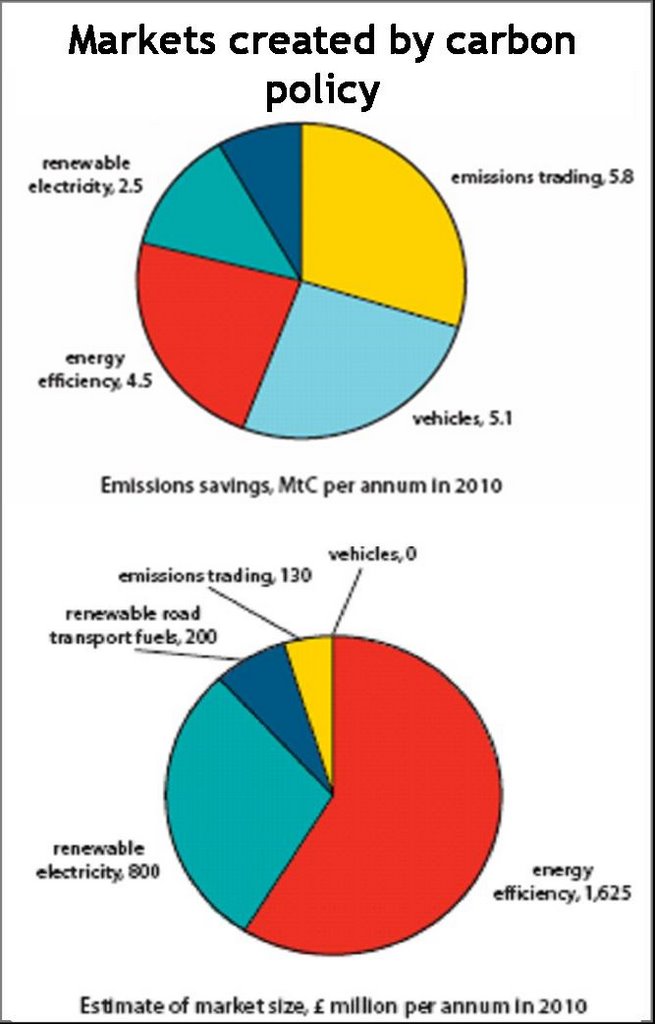
The particularly good thing about it is that it shows in clear terms how a market for environmental goods and services forms - primarily through policy interventions, as 'the environment' doesn't establish a demand and pay in its own right. The chart shows the expected environmental value of the policy intervention in avoided carbon emissions
(top) and the expected value of the market for environmental goods and services thereby created in £million (bottom).

Long, loud and legal - the value of strong interventions
It's because of this market-making function that forward-looking business groups (eg, WBCSE) call for the policy framework to be 'long, loud and legal' - if the signals from environmental policy are sufficiently long-term, clear in intent, and intolerant of free-riding then they will stimulate investment and R&D to meet future demand. Campaigners also see the role of policy and regulation as moving 'From Red Tape to Road Signs'. Yet this seems to be what policymakers are reluctant to do... often seeing 'innovation policy' as direct government spending on R&D or dealing with failures in the venture capital market (see DTI innovation pages for a flavour - very little mention of the importance of the government acting clearly and consistently).

100,000 jobs would be nice... but what will create them?
In his 2006 conference speech, the Chancellor announced:
I will publish proposals this autumn showing how environmental care and job creation advance together: from energy saving, innovation and green technologies. At least 100,000 new jobs for British people.

One of the most important ways to cause this to happen would be to clear about the direction of environmental policy, especially for carbon. In the case of the long term market for low carbon there remains great uncertainty and very ambiguous signals to investors. The Energy Review chapter on 'Valuing Carbon' did little more than make statements of intent about the future of the EU Emissions Trading System (which UK cannot deliver on) and left us with the following: We will keep open the option of further measures to reinforce the operation of the EU ETS in the UK should this be necessary to provide greater certainty to investors.

It doesn't even say when and how 'necessity' would be judged. It also reminds investors that the are several forces that make the prices even less certain in the future - the role of the Clean Development Mechanism and joint implementation etc (making cheaper emissions reductions outside the ETS system - but adding uncertainty to future prices.

Uncertainty or credibility?
Dieter Helm's discussion of Credible Carbon Policy and his proposals for Carbon Contracts to give a clearer signal for long term carbon policy should be required reading for the Chancellor's team, as they work out how to generate 100,000 jobs. It will need more than the recently announced Environmnetal Transformation Fund (details to follow...!) and a few spending initiatives to deliver really vibrant environmental markets...


The Vivid Economics report concludes:

On the basis of the UK Government’s plans to tackle climate change (the compliance market) and the emerging voluntary market, the UK market opportunity alone will be worth £4 billion a year by 2010. The compliance market resulting from the UK Government's climate change programme over the next 10 years will be worth around £30 billion or more. The compliance market is growing primarily because the UK is tightening building standards, bringing forward renewable electricity and biofuel schemes, and tackling the energy efficiency of dwellings.
There's a lot money in environmental policy, and the strongest driver of national comparative advantage will the quality and strength of policy signals to UK firms - ie. intervention. That's a difficult and counter-cultural idea for policy makers that have spent years sympathising with businesses about 'regulatory burdens' and red tape.
... continues. Read full post.

Tuesday, June 06, 2006

Killing by the million - and that's just the health campaigners...

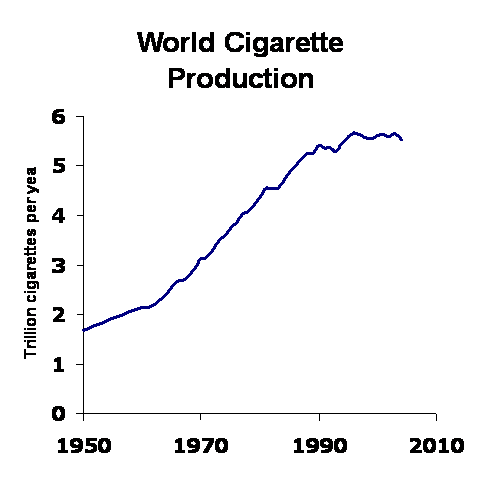
World cigarette production is about 5.53 trillion sticks per year. (about 2.4 per day for every single person in the world). This is stabilising as people in developed countries quit and growing populations in the developing world start puffing. According to WHO's tobacco group, death-toll from this is now about 5 million per year, heading for 10 million. With perhaps 1 billion potential premature deaths at stake in 21st Century on current trends. In other words it's huge.

What is absolutely amazing though is that there are forms of tobacco use about 10- 100+ times less hazardous than smoking (ie. chewing, sucking - anything non-combustible) - it's the smoke that really kills. Widespread use of these is why, for example, Sweden has the lowest rates of cancer and heart disease in the world. If the world tobacco market shifted to selling more of this and less cigarettes, millions of premature deaths could be avoided over the 21st Century. But true to form, the well paid and comfortably smug public health community refuses to accept this concept and adopts a counter-productive prohibitionist stance - hoping naively that if people have a choice between quitting and dying, they'll choose to quit. Inconveniently, tobacco is highly addictive, so many wont or can't choose to quit and will
die. So instead of telling the truth about low risk options, there is a conspiracy to lie and mislead (for example, the US Surgeon General told a barefaced lie about it to Congress). In Europe, we even have a directive (2001/37/EC see article 8 and 2.4) that bans the much lower risk products than cigarettes. If there is a reason to be a Euro-sceptic, then this is one of the strongest - deliberate denial of access to products that are much lower risk to people that are addicted to nicotine.

I feel very strongly about this, so last night I met with US Smokeless Tobacco to encourage its new chief executive to make his target market the erosion of the 5.5 trillion unit cigarette category. If he achieved that, I think they'd save more lives than most of their opponents in the public health community. he didn't need much convincing.
... continues. Read full post.

Saturday, June 03, 2006

Microsoft - give me a mekko chart now, you useless, greedy monopolist!

Annoying!!! I want to do something simple... plot a bar chart for a bunch of countries where the width of each bar = the population of the country, the height of the bar = its GDP/capita and hence area of the bar = its GDP. Clearly an insane requirement - who would ever want to display world poverty in such an obvious way? This type of chart is called a 'mekko' or 'marimekko' chart (example to the left). After years of new versions and irritating paperclips and lots of other rubbish, can MS Excel even do this? Er, no... Ray Ozzie was hired by Microsoft to buff up its sagging innovation record. His excellent memo Internet services disruption took the lame corporation to task for its record on innovation. Despite having a $7 billion R&D programme they've been hammered by Google on serach, Blackberry on mobile, iTunes on music, Sony on games... and so on. R&D and innovation... two very diffrent things.
... continues. Read full post.

Tuesday, May 30, 2006

The under-performing British consumer

Just back from an excellent break in the Lake District, but had cause to reflect on the reasons for Britain's poor record on economic productivity compared to the US. I'm convinced it's little to do with the rise of China taking all our jobs, the failing biotech revolution, poor R&D spend or any of the other reasons usually offered. No, it is something much closer to home: the underperforming British consumer is to blame.

The basic reason is that Brits too easily put up with rubbish service or products or are too undiscerning to notice that's what they have been offered. This allows poor service to persist in a service economy and weakens selection pressure between providers, denying businesses offering high standards their just rewards and sheltering businesses that should go under or be taken over.


Many people think the future is in hi-tech - but a much larger part of the economy is based on everyday things you can complain about and so force the pace of productivity growth. For example, only 0.73% of the value added in the UK economy comes from pharmaceuticals, but retailing, hotels, pubs, restaurants and recreation services account for about 12%* - and this is where where complaining really makes a difference. And once the link to our national economic virility is understood, complaining becomes truly a patriotic duty. As you send back that over-cooked salmon for the third time, you really are making Britain more prosperous.
So, it is vital that we are all up to speed on this - please see Art of complaining for guidance on tackling useless restaurants. Visited one in Grasmere while on holiday, The Swan Hotel. Food was okay, but there were no less than ten complainable incidents in the evening. I'm proud to record that only one of these passed unremarked. That was the truly awful muzak - some ghastly collection of romantic bombast, with bloody Paverotti singing My Way and worse. And we did have them turn the volume down.

* For more on the breakdown of the economy see National Accounts Input Output tables - it's a surprise what goes into our GDP!
... continues. Read full post.

Saturday, May 20, 2006

Thames Water - why water metering needs to be mandatory

Just received a slightly irritating letter from Thames Water cheerfully suggesting: "Let's beat the drought together". At no point in the letter do they suggest that customers should ask to have a free water meter installed. Yet when people actually pay for the volume they use, they do actually use 10-20% less on average. Even in the advice on saving water section on their web site they decline to suggest it. But meters are essential for fair charging for water, efficient use and sensible tariffs.

Water companies have reasons to avoid water metering. Though they are the main player in the water-stressed South East, Thames still expect to have less than 60% of houses on meters by 2030. I think we rely too much on the water companies to decide on water-metering and promote it only as a last resort. It should just be made mandatory as part of the water supply licences, with new legislation if necessary.
... continues. Read full post.

Thursday, May 18, 2006

Is this a Garden Table of Death?

I've just done up my garden, including the purchase of a new garden table. I went to crocus.co.uk and ordered on-line.... and here it is pictured on-site. Crocus' hardwood guarantee includes:

Today, all our timber comes from strictly managed forests that have been checked and approved by the Tropical Forest Trust (TFT). In fact, we are the only leading online garden furniture supplier that can guarantee all their hardwood furniture is made from timber sourced from forests working with the Tropical Forest Trust (TFT) on a strictly controlled management programme towards independent certification.

But when it arrived the packaging said "Made in Vietnam" - my heart sank and I thought I must have been conned because, I thought, what an earth does sustainable forestry mean in a place with lots of old growth tropical hardwood forests? So I contacted my friend Jade Saunders who works at Chatham House and is an expert on illegal logging (www.illegal-logging.info ).

Thankfully, my narrow-minded pessimism was given short shrift as she replied:
"It may not have been harvested in Nam but it will have chain of custody back to stump. The Tropical Forest Trust work with forest managers, often communities, towards FSC certification. They have total integrity timebound targets & people getting kicked off the programme if they don’t get their sh*t together."

... continues. Read full post.

Monday, May 15, 2006

Nationalise infrastructure?

Was presenting at an interesting Oxera conference today. Amazing suggestion - not quite a proposal - from one famous speaker... when the government stands behind the main networks, as it always will.... electricity, gas, water etc. why does the consumer pay market interest rates (as the government ultimately bears the risks)? In other words, why not give these operations quasi-public sector status and let them borrow at the Treasury rate, making it cheaper for the consumer?

A most unexpected place to find the incubation of the coming era of 'new' socialism...
... continues. Read full post.