Showing posts with label Economics. Show all posts

Wednesday, November 14, 2007

Asking the wrong question - biofuels

I don't want to do a full scale critique of biofuels - not least because that would be to enter an already crowded field [see Biofuelwatch and Global Subsidies Initiative, for example]. But it's worth looking at how narrowly-focussed, bottom-up policy-making now means we have somehow put the most financial support into the worst ideas...

Instead of asking how to reduce transport emissions from road fuel substitution, we should be asking how to make use of land to tackle climate change in the most effective way possible. In coming up with the biofuels targets, policy-makers have asked, and answered, the wrong question. It's not hard to see why... transport policy-makers have to find transport policies. The results: waste, damage and lost opportunities to do better...

... continues. Read full post.

Sunday, November 04, 2007

Heads you win, tails I lose - the City explained

Imagine your job is taking huge gambles with other people's savings and pensions. Imagine also that the bets are arranged so that you are paid a fortune when things turn out well, but you don't lose anything much when they go wrong. How would you behave...?

I think you might rapidly develop a hog's appetite for wild risk taking. And that is, in essence, what is wrong about the financial markets - the incentives of individual traders and managers are not aligned with the interests of those whose money they manage. The pay system based on big bonuses creates a sharp asymmetry in rewards for success and penalties for loss. There are no negative bonuses that penalise big losses. The worst that can happen is a few months gardening and a pay-off that would dwarf most people's regular pay. The institution, its shareholder or investors take the pain - not the trader or manager.

... continues. Read full post.

Thursday, November 01, 2007

Buddy can you spare a trillion? The EU budget review

Way past bedtime on 17th December 2005, frazzled European leaders decided how to spend just under one trillion Euro. They set the EU's budget framework from 2007 to 2013 - and committed €947 billion or just over 1% of EU GDP over the period. The chart shows the breakdown of the 2007 budget by major theme - dominated as ever by agricultural subsidies and 'regional' policy or what is now known as 'cohesion' policy (spending in poorer regions of the EU, supposedly to bring them closer to the EU average).

The full budget from 2007-13 is in this spreadsheet [XLS] [source data]. You can also look at the 2007 Budget at a glance or expenditure by programme to see how the Commission describes it, and at an even more detailed material in the EU Official Journal if you want to risk insanity and blindness. Probably the best guide to how the budget is intended to be used is still the Commission's 2004 proposal, Building our common future.

... continues. Read full post.

Tuesday, October 09, 2007

Severn barrage - flawed economics

Note: this follows an earlier posting on: The case for the Severn barrage - does it hold water?...

Sometimes you can be wading through a report and hit something that abruptly tells you it isn't really worth reading on: the report is mad and you are wasting your time. And so it happened when reading through the SDC report Tidal Power in the UK, and coming across Table 33 on page 119 - see left.

This shows the cost of the Cardiff-Weston Severn barrage for different discount rates (the horizontal lines), compared to other low carbon technologies (the bars). The report declares:

...at an 8% discount rate, [the barrage options] lie at the higher end in comparison to other low carbon technologies; at 15%, they are well above the costs of all other technologies except wave power; but using low discount rates of 2 or 3.5% a barrage becomes highly cost-competitive.

Oh dear...! If you were also to assume a very low cost of capital (discount rate) for the other technologies, they get much cheaper too! So the costs given for offshore wind or nuclear, both highly capital intensive, would be much lower if they had 2-3% discount rates and the bars would shrink below the lines. The chart is distorting and meaningless, but it does rather betray the tendency to appraisal bias that pervades the report. About this there is more to say....

... continues. Read full post.

Sunday, September 30, 2007

The Merton Rule - an investigation

Once it was famous only for the '70s Mod-revival band, The Merton Parkas. And, frankly, it wasn't that famous even for them. But now the London Borough of Merton is famous for the eponymous 'Merton Rule'. As the map left shows, local government across the nation [list] is at various stages of implementing the Rule. The Merton Rule is a planning condition requiring on-site generation of renewable energy:

All new non residential developments above a threshold of 1,000sqm will be expected to incorporate renewable energy production equipment to provide at least 10% of predicted energy requirements [Merton council site][Merton Rule site]

The intention is to develop this to residential development over 10 units and possibly to increase the percentage to 20%. But a storm has erupted: the champions of the Merton Rule believe the government is about to put a stop to it in a craven capitulation to the building industry, which doesn't like the high costs of complying and has the government over a barrel on delivering targets for housing growth [see recent Guardian articles: Don't scrap green housing rule, urge campaigners and Green groups warn energy minister against U-turn]. The case for the defence has been developed and a petition opened on the No 10 web site. Let battle be joined!

... continues. Read full post.

Friday, September 21, 2007

Case for the Severn Barrage - does it hold water?

There's speculation in the papers [last weekend's Guardian, earlier in the Independent] that the government is to back the Severn Barrage. This huge project would capture renewable energy in the tidal movement of water in the Bristol Channel - the tidal range is one of the highest in the world: up to 15 metres. There have been various designs and locations proposed, but the leading one is promoted by the Severn Tidal Power Group of major construction companies (see picture left and this 2006 presentation by the group making their case). The Sustainable Development Commission is shortly expected to produce its report on tidal power, and we should have much more data and analysis to consider at that point. But I thought I'd get my own thoughts on this straightened out in advance.

The inevitable question must be: "is this scheme bonkers?" In my view, bonkers would be too strong - but I can't see the case for the Barrage now.

... continues. Read full post.

Saturday, September 15, 2007

It could be worse - winter fuel payments

In my last post I asked for nominations for a worse policy than the proposed 'Health in Pregnancy Grant'. An anonymous contributor proposes the Winter Fuel Payment, which is designed to help pensioners fight off the cold over winter. I think 'anonymous' may be on to something...

As the chart shows, this unconditional payment has now reached about £2 billion per year, and over £12 billion has been spent on this since 1997 [data from PQ, 27 Jan 2007]. Payments of £200 are made to over-60s and £300 to over-80s [guide] ostensibly to see older people through higher winter fuel bills. So this shares with the pregnancy grant two characteristics: very poor targeting of the needy group and very poor link to the stated objective. But it is much larger, and therefore is a bad policy on a larger scale. Could this be done better? It could hardly be done worse...

... continues. Read full post.

Wednesday, September 12, 2007

Land use and food security

One of the big questions for me is whether we devote too much land to farming and not enough to land use for wildlife, wilderness, woodland, places to walk and places to live etc. that is land for its 'amenity' value or for development. About 70% of England is given over to farming and only about 10% to development (see my earlier posting), yet surveys show most people think that much more land (>50%) is developed than really is (see Q1 in this survey for the Barker Review). The survey also shows that people have strong preferences for land for its wildlife and landscape value (Q3).

So, why don't we have more national parks, reforest large areas of rural England, get most of the sheep off the uplands, switch to extensive low impact agriculture producing high-quality and high-value foods, open up access to land, fill the countryside with helpful signposts and paths and let people enjoy living in England? I was out walking in the Thames Valley this weekend - very nice, but I did wonder why there was so much sheep farming going on what must be some of the most highly prized real estate in the land. An occasional sortie out of the city reveals just how much space there is given over to low value agriculture, even in crowded South East England.

The argument that usually comes back is some variation on 'we need domestic farming for food security' or worries about the loss of self-sufficiency in food production. We might become more dependent on food imports, and that would be A Bad Thing. So how credible is the food security argument? Indeed, what exactly is the argument? I think it takes us to the heart of the great debate about land use that there ought to be. In summary, I think the food security argument is entirely bogus, but a key question for land use policy becomes 'how much should we consider the international impacts of what we do domestically?' ...

What is food security?
Most definitions [here][Wikipedia] are based on people having access an adequately nutritious diet. But the concept spans a range from having sufficient calories to remain alive to maintaining affordable choice in the diet - kumquats in January and affordable Piedmont white truffles at all times. Although often expressed in terms of access, food security is really an economic concept - about having the means to buy food, and about being near enough people with the means to create a market. Even the worst famines rarely arise from absolute food shortages, but loss of purchasing power and market failures (See Economist on Niger famine, Amartya Sen, Poverty & Famines) and few people actually starve in a famine - rather they die through infectious diseases. The symptoms of food insecurity are high or volatile prices. We should be clear, food security is first and foremost a problem for the poorest developing countries and for poor people everywhere.

Promoting self sufficiency - but why?
Much is made of self-sufficiency in food production - for some the declining 'self-sufficiency ratio' (see chart above [Defra data Table 7.4]) is a crisis. The National Farmers Union (unsurprisingly) sees it as vital.

In 1996 we produced more of our own food, and for a higher population, than at any time since the mid-nineteenth century. But that level of self-sufficiency has been falling. In the last 10 years, overall self-sufficiency has fallen by 18% and self-sufficiency in indigenous foods by 15%, as a result of lower UK production, reduced exports and increased imports. The figures look stark... [From first page of the NFU's case for farming: Why farming matters - December 2006].

Actually, our self sufficiency depends on how you look at it. The lower chart is derived from the FAO Food Balances' (see here), but presented as calories per head per day rather than in prices. The food balance looks at production, exports, imports and consumption of food and as inputs, such as feed and seed. The self sufficiency ratio is domestic production divided by production + net imports. On this basis, we are 83% self-sufficient in calories. See my Google spreadsheet [XLS], which sets out the food balances for the UK and a few other countries extracted from FAO. The lower chart above summarises the spreadsheet for the UK - it breaks down self-sufficiency into different food groups.

We are self-sufficient in the most important food group in energy terms, cereals. Where we are a net importer, it is primarily for meat (New Zealand lamb, Danish bacon etc) where others have advantages in production, or for things we like but don't grow here (fruit, olive oil). We tend to import higher value foods - but these are to some extent the excitement and choice in our diet, not the raw energy content.

But so what if we do import food?
What would higher self-sufficiency actually do for us? Not much actually. Domestically produced food still gets more expensive when world prices go up - so it doesn't somehow protect our people. In fact we end up at greater risk that pest, drought or some other rural plague will strike down domestic supply. It would matter for the economy if we were a huge importer or exporter and the agricultural sector was a substantial part of the economy - in which case we might worry about terms of trade shocks or other bad things that world markets might do to us. But we aren't, it isn't and we don't need to.

Agriculture accounts for only 0.9% of UK GVA, about £9.6 billion, and it is the small player in the £80 billion UK food industry - food manufacturing accounts for £21 billion and distribution and services, such as restaurants, £49 billion. The agriculture net negative trade balance is £4.9 billion (ie more imports), but this is less than the £6.1 billion net imports of office machinery and computers. We are 22.5% important dependent in agriculture, but 52% import dependent in computers and office equipment. [Source: ONS Input-Output Analysis, 2006]

So should we be more worried about importing food or computers? Answer: neither.

Trade is the basis of food security
Trade enables us to buy more food, more cheaply and with greater choice. A very good report by a team in Defra makes this case extremely well [Food Security in the UK: an evidence and analysis paper]. Strangely this seems to have popped out just before Xmas 2006 - usually a sign that something is to be buried! Maybe it was that it came a few days after the NFU report on Why farming matters.

As the authors say: The conscious or unconscious identification of food security with self-sufficiency has often obscured the real issues... and ... a discourse centred on ‘UK self-sufficiency’ is fundamentally misplaced and unbalanced.

The importance of markets in securing food supplies is well illustrated in charts included in the report (left). For vegetables, countries within the EU have varying self-sufficiency. But the EU is overall almost self sufficient. For fruit, some countries barely grow it all, but the EU meets most needs (but can't grow much tropical fruit). Over time, the EU has become more dependent - but that probably reflects an increasing taste for fruit, lowering tariffs that allow access to lower cost producers, taste for more exotic fruits not grown in the EU.

The point is that markets and trade deliver food security, diversity and resilience in the supply system. The report concludes:

International trade has long been a central feature of UK food supply, and has remained critical even during times of emergency. There is no reason to suggest this will be less in future. At the very least, UK food security is tied up with the EU single market and, ultimately, the efficiency of the world trading system.

I think the big question about land use in England is how much we care about the international impacts of decisions we make about UK self-interest... there are two in particular: the international environmental footprint and the impact of our land choices on the food security of others.

Exporting environmental footprint...
I hope you might be convinced that 'self-sufficiency' in food isn't a worthwhile objective in its own right, and may even be harmful - it certainly has little to do with food security. But what about the argument that we are simply exporting the environmental footprint associated with food production? We could turn England into a pristine green and pleasant national park with all industrial farming removed. But food production, fertilisers, water pollution, biodiversity impacts and all the rest would go abroad.

The first thing to note is that this is absolutely the norm - we do this for manufacturing, mining and other high impact activities. Much of our polluting is done elsewhere. At the heart of this is the theory of comparative advantage and our preferences. Rich English people have a high and increasing preference for good environments (articulated collectively through numerous laws, codes, the planning system). Other countries may relatively favour more aggressive and polluting activities and prefer money raised through production of goods to sell to us. We have traditionally respected this as a matter of 'national sovereignty' and resisted what some would call 'environmental imperialism'.

I think this reluctance to impose extra-territorial standards will and should continue, with an expectation that food standards and costs will rise globally and that more countries will emulate the EU and set high environmental standards as they become more prosperous. But I think there should be one exception to pure national sovereignty - where the impact is on a 'global public good' ie. something we should all bear responsibility for protecting because it's value is global and it has characteristics of a public good. If the system behaved in such a way that for every hectare of land taken out of agriculture in England a hectare was felled in the Amazon or Borneo, I'd be troubled. I'm not sure it would behave in that way, but the challenge there is to develop global collective action to provide global public goods.

PS. we should be very sceptical about 'food miles' arguments (see my earlier posting: Food miles... wrong idea, stop using it!)

Impact on the poorest...
If we use UK land for producing 'non-marketed' goods that we have high demand for (like leisure, views, woodland walks and biodiversity), then we are adding to the pressure on available productive land to meet food and energy needs globally. That doesn't hurt us too much, as we simply buy access to the necessary land through international trade. But does it hit those who are the poorest? To be honest, I don't know...

How it could make things worse...
Pressures on land may grow - fuelled by population growth, economic growth, a tendency to consume more protein with increasing wealth, demand for biofuels and climate change and other pressures degrading the available land. This would be globally serious if agricultural productivity growth (increasing yields per hectare) did not keep pace with these pressures. Land prices and agricultural commodity prices would increase and the poor may be unable to afford sufficient food. In fact, the productive capacity of the land may be globally insufficient to support the world population. The poor would be the inevitable losers.

Why it might easy to overstate the problem...
If land and food became scarce, we might expect those poor countries with agricultural economies to benefit from rising prices - just as oil producers (in theory at least) benefit from rising oil prices. A new green revolution might boost productivity and food production might shift, with perhaps Ukraine and Russia becoming bread-baskets of Europe, for example. As prices rise, there may be reconfiguration of the diet - perhaps with less resource-hungry protein consumption. Famine is rarely caused by absolute food shortages - and there is unlikely to be a global food shortage in absolute terms. Richer poor countries would have a better grip on their food security.

The international consequence are a critical question for land-use strategy
As I suspect is apparent, I'm not really sure how the international consequences of domestic land use choices would or should really play out. But what I am sure about is that these are critical questions for a future land use strategy. At the moment we generally do not act on these consequential impacts (in fact we usually wilfully ignore obvious damage caused by key farming policies like the CAP). But is this hard-headed and basically right, or does it belong to a pre-globalisation era of narrowly defined national interest?
... continues. Read full post.

Wednesday, August 22, 2007

When rich countries make emissions cuts in poor countries

Yvo de Boer, head of the UN Framework Convention on Climate Change (UNFCCC) argues that richer countries should be able to buy as much as all their emissions reductions through investments in emission reductions in developing countries [see BBC / interview]. Given the global atmosphere is indifferent to where on the surface the reductions take place, there is an argument that countries with obligations to cut should make the emissions cuts where it's most cost effective. As long as the rich countries do the paying, then they would not be shirking their responsibilities. Or so the argument goes. And this argument is more plausible than its critics admit - the polluter is still paying, but in theory paying where the cuts are most efficient and thus squaring equity and efficiency objectives. However, the argument is also wrong. The main problem is long-term structural change...
... continues. Read full post.

Saturday, August 18, 2007

Escaping the reckless EU renewables targets

The Guardian exploded with indignation this week [Revealed: cover up plan on energy target; leader; letters], at the discovery of a leaked government memo discussing how the UK might wriggle out of a European Union renewables target - to reach 20% of EU energy consumption from renewables by 2020. In fact, the real story is different and more worrying than the Guardian has it. The real problem is how this target ever was agreed in the first place and the negative consequences for climate change that will flow from it. It might seem counter-intuitive to see a highly 'ambitious' renewables target that way, but I think these targets an own-goal that will discredit the EU, cause negotiating sclerosis, distract from more important objectives, and fail to deliver what would in any case have been the wrong approach, whilst missing renewables targets for 2010 by miles. I think this is bad policy and the civil servants are right to be looking for a way out, so let me explain why...
... continues. Read full post.

Saturday, August 11, 2007

Cap and trade for cigarettes?

If a country wanted to reduce tobacco use to a level that meant it was comparable with other public health risks, then why not simply reduce the amount that can be sold or number of customers they can have, by allocating quotas to manufacturers and allowing trade in quotas? This proposal has surfaced in the US as a legislative proposal: Help End Addiction to Lethal Tobacco Habits Act (geddit?) [full text] by Senator Enzi. This is partly in response to the pointless industry-sponsored Family Smoking Protection and Tobacco Control Act , which mystifyingly also attracts support form big US public health campaigns. I think have vested misplaced faith in regulation and regulatory bureaucracies. The Enzi approach is an alternative and the idea also has people talking in the public health world [article in New Zealand Herald and here]. But does it make sense? I'm not so sure... here are a few tentative thoughts (and I'd welcome responses from those promoting the idea)....

1. What does cap and trade add compared to increasing taxation on tobacco? Both systems tend to raise prices and bring supply and demand into line. Taxes, however, have the great benefit that the premium paid flows to the government, rather than the tobacco company (unless the quotas are auctioned, which I would recommend as an amendment to the Enzi Bill, in which case the premium flows to the government, but adds a lot of complexity).

2. The 'allocation programme' is cumbersome. Based on historic market share, Enzi's proposal grants important rights (effectively access to market) to incumbents. Again it could be improved by auctioning quotas, but adds nothing to cigarette taxes. The Enzi proposal actually makes the number of users the regulated quantity... but given the great heterogeneity in what makes a user and how much this changes over time, this is a really poor idea for a regulatory base.

3. Control of price volatility will dominate quota setting. This is a major problem with cap and trade systems (and we are suffering from this in the EU Emission Trading Scheme)... Whilst it is possible to set, quotas as Senator Enzi does, that give a desired outcome with certainty, in practice politicians are not indifferent to price hikes in widely used products. The result will be a fudge on quota setting that effectively guarantees that the price volatility is manageable. An economist's view is one thing, but these ideas have to be seen in terms of political economy.

4. Physiology. Smokers control their nicotine dose from smoking and, within limits, can get their fix from fewer cigarettes. This effect is already seen with poorer smokers, who will often smoke fewer cigarettes but achieve a higher blood-nicotine level by smoking more intensively. This is an issue for taxation of course, but proponents should remember that there isn't a linear relationship between a quota (whether number of sticks or number of users) and health impact.

5. Gaming. With complex regulation and definitions, there always comes the scope for innovative gaming. And you would surely expect that here. If the quota is users, can some new product be designed that takes them out of the user definition? Can users be encourage to lie to surveys? If the quota is measured in product terms, can longer cigarettes be introduced?

6. Scope of responsibility. It's generally a good principle of regulation to give organisations duties or targets only for things they have control over. Tobacco companies don't control the number of users, they are just one influence - health care support for quitting, taxation, public health advertising, smoke-free policies, marketing restrictions are all more important. They can control the quantity of product they sell and its price.

7. Legal constraints. The slightest sign that the allocation regime disadvantages importers or foreign brands, then a challenge at the WTO would be expected. In fact, it would happen just to get in the way. Anti-trust law or other consumer protection principles might be expected to be deployed by those disadvantaged in the market carve up. What would happen when people wished to bring in cigarettes they'd bough overseas?

8. Distraction. This could tie up administrators in knots and expend valuable political capital to little purpose. I think there is only a limited role for supply-side interventions in reducing harm from tobacco. these are primarily by:

  • raising the price through taxation that keeps pace with growth in incomes, and so reduces affordability of tobacco use over time;
  • differentiating the tax rates according to the harm. I strongly support a much lower tax rate for smokeless tobacco products and no tax differentiation between smoked products (eg. by tar or nicotine yield) as there is no real health difference between smoking products, whatever you've been led to believe about 'lights' etc.
  • giving meaningful information to tobacco users about relative risk of products - again, especially about the vast difference in risk between smoking and smokeless tobacco.
More important are the measures designed to act on the demand side - smoke-free policies, advertising bans, support for quitting, counter-advertising being the most effective.

9. Finally, an advantage. Where taxation is a dirty word and political non-starter cap and trade systems can have much the same economic effect (raising the price at the margin) but may be more easily implemented than a tax. Something similar happened with the US Master Settlement Agreement in which State Attorneys general sued the companies for health care costs, won $250 billion settlement, causing the companies to raise prices by 40-50 US cents to pay for it. Not far off taxation, but a lot of lawyers got rich too. I think lawyers would do well from a cap and trade system too... and that's never a good sign.

Of course... I very much doubt Senator Enzi's proposal will go anywhere, but always worth discussing innovative ideas.
... continues. Read full post.

Thursday, August 09, 2007

Achieving culture change

An excellent new publication from the Prime Minister's Strategy Unit, Achieving culture change: a policy framework. It's open for discussion until 31 August and will be finalised once they have had views in. It's an important area because many policy objectives depend on influencing, or are thwarted by, deep-seated attitudes and entrenched behaviours... environment, skills and employability, anti-social behaviour, and public health to name a few.

This develops work on 'behaviour change' (see my posting on soft paternalism for a discussion) to reflect the idea that behaviour is embedded in culture: a stock of attitudes and beliefs - and that behaviour is conditioned by culture, but that changed behavioural norms are eventually consolidated into culture (see graphic from report). If that sounds either obscure or so obvious it isn't worth stating, I think it is worth having a read of the report - it's an excellent synthesis of the knowledge and experience in this area with some good analytical tools...

I attended the launch of this report and was asked to give some remarks in response. My six main points were as follows:

1. Death of 'rational man' economics. As soon as real world behaviour and culture are examined, it is obvious that the key assumption of utility maximising behaviour (where utility is usually erroneously conflated with income) fails. One quite (I suspect inadvertently) amusing part of the report is on page 58, where a list of behavioural 'biases' are noted in which human behaviour departs from the rational model. In most of science, when the model is different from reality, we usually conclude the weaknesses and biases are in the model, not the real world! Only economics can suspend humility I recently read The Origin of Wealth, by Eric Beinhocker a fascinating challenge to the highly deterministic and reductionist assumptions of classical economics, in favour of 'complexity economics' comprising system dynamics and emergent behaviour, agent interactions, networks, and evolutionary models for innovation and markets. But much policymaking rests on the simplistic and wrong assumptions of neo-classical economics - in fact it is elevated to the status of religion in some quarters. If not time to bin it, then it's time to recognise its limitations - I'm arguing its approach is sometimes necessary (eg. getting prices right), but rarely sufficient to deliver desired outcomes.

2. The importance of time. The report is a manifesto for 'slow wins' - substantial changes achieved over a long period, in which interventions to change behaviour become self-sustaining and consolidated into culture. Time is much underrated in policymaking but it is critical in reducing transition costs and allowing everyone to adapt. So for example if there was a desire to apply a high carbon tax (say £50/tCO2) it could be introduced over 10-15 years. There has been a steady culture change effect around domestic violence - once the police deciding to ignore 'domestics', implicit societal permission to thwack the wife was withdrawn, and domestic violence has fallen very substantially over time. Most of the great changes in society have been realised over many years: slavery abolition, universal suffrage, the Enlightenment rejection of religious dogma, human rights, etc.

3. The moving policy frontier. Attitudes and culture change over time, and what is impossible at one point, may become acceptable as time passes and attitudes change. The 40-year effort to restrict smoking in public places is a good example (see post on lessons) and there is a good discussion of this in the report. With recycling there has been a steady change in attitudes, and ideas that were ahead of their time just five years ago, are under discussion now. See PM Strategy Unit 2002 report Waste not, want not, which recommended charging households for the amount of rubbish produced and caused a storm at the time, but see 2007
Defra announcement and BBC.

4. Credibility and consistency. If long term culture change is the objective, then everything done needs to show the direction is consistent and the intention credible - otherwise the signal is mixed. Perhaps this problem afflicts us most in responding to climate change... the language on climate change is strong, but in other policy areas the signals about climate change are are mixed - eg. housing, transport and even energy. I think was done well with drink driving, where detection, penalties, advertising etc all lined up with a single clear message. Culture eventually changed and no-one jokes
any more about driving home because they are too drunk to walk. One argument I made for consistency reasons was to build on, not replace, the behaviour change model of the 2005 Sustainable Development Strategy: Securing the future, chapter 2.

5. Where does the mandate come from? Intervention in behaviour and culture change can be paternalistic or appear paternalistic. How does the government secure a mandate from the public to do this? The report p30-32 gives a characterisation based on liberal principles governing the case for government intervention (though the 2-dimensional space drawn on p32, doesn't reflect the case where people cannot exert full 'agency'). However, I think this is only part of the story. It gets to the heart of the relationship between a government and its electorate. I recently attended the Green Alliance summer garden party and debate: Is it up to politicians to save us?, which was excellent - but the question begs a careful answer. I don't see politicians as simply aggregating public opinion - we usually elect them to lead us, and lead us beyond where we currently think we are or want to go. That is, we place some trust in them. We give them a metaphorical tow-rope and ask them to tow us along in what looks like the right direction. Sometimes they can go too fast or be excessively libertarian, authoritarian or paternalistic, and the tow-rope reaches its elastic limit and then snaps - in a 'crisis' (like the fuel protests, too much immigration etc.). If we trust the politicians less, we reel in the tow-rope and give them much less scope. the important thing is that the public ultimately controls the 'permission' it gives to politicians, but politicians can act in such a way that they enjoy greater just and more slack... consistency, credibility, taking times, avoiding excessive intervention, listening etc.

6. Where is the space for this sort of policy work? Chapter 4 (p66) sets out a seven part policy framework for operationalising the ideas in the report (see diagram below - click to enlarge). My observation is that this sort of work is a very substantial undertaking, and it's far from obvious to me that the civil service is geared up to do this. I think it needs: ministerial buy-in and patience, multidisciplinary teams, time and resources, developing a programme of policy-focussed research, clear agreement on problems and scope.


The fat tax - my confession... I also offered the meeting a confession - it was me that penned the infamous 'fat tax' concept into the PM Strategy Unit's earlier work in this area [Report: Personal responsibility and behaviour change] causing the report to be changed following another media storm (see The Times, BBC). I thought I was being clever by saying that it would be a tax on food not bodyweight!

Needless to say, this idea is eventually percolating into the mainstream - exactly as you would expect as concern mounts over obesity [see recent articles: Doctors call for Fat Tax, Institute of Fiscal Studies report, Fat tax could save thousands of lives, Fat tax would be a throw back to the nanny state: so what?, Shouldn't we tax fatties? ]. I suppose the lesson from this is that the government should allows others to make the running (even if it is egging them on), so that an idea seems to be a natural progression of policy. This was an example of stretching the policy frontier too far, too quickly... but given this frontier is moving, it's time will surely come.

... continues. Read full post.

Tuesday, July 24, 2007

Emissions trading - notes on a scandal

Another day, another broadside against carbon emissions trading. The FT's Martin Wolf offers advice to the new Chancellor, including:

While simplifying tax, he should also take a close look at green taxation. Simple taxes that apply across-the-board are what is needed. The grant of valuable rights to big polluters through systems known as “cap-and-trade” is a scandal. [here]

This is an increasing theme, with even American giants like Alan Greenspan and Paul Volker coming out against cap 'n' trade and in favour of a carbon tax [see article]. I have to say I'm ever more swayed by this view, see my posting To Cap or to Tax.

But is the EU system 'a scandal', as Martin Wolf says? You can certainly make the case - the permits are given away to businesses, but they are valuable because they are scarce 'property rights' - the right to use the atmospheric sink for carbon. It's hard to put an exact value on these permits - see charts of the market price for EU allowances from Point Carbon showing the collapse of price in 2007 but a steady price of about €20 so far for the future price of 2008 EUAs... but in total they are worth a great deal.

€billions for what purpose?
So if, say, €20/tCO2 is used to give an illustrative value of the ETS price, the value of the rights to emit over 200MtCO2 to UK industry comes to over €4.3 billion. To the power sector alone, it comes to €2.7 billion (see numbers in this Google spreadsheet based on 2005-06 ETS results [XLS]. The power sector is especially annoying because it actually passes these costs on to the consumer, even though it doesn't actually pay for the permits, which are mostly given away in the EU system. They have adopted this as an accounting convention, reflecting the opportunity cost of holding the allowance for each unit of electricity sold. They can pull this trick off because they are an oligopoly and don't face competition from producers outside the system. So even allowing for the permits that they have to buy because they are given fewer allowances than they need, the power companies profit from this by €1.8 billion... and the bigger and dirtier they are, the more they make, because allowances are given to them in proportion to their historic emissions! What exactly is the public purpose served by transferring billions from energy consumers to energy company shareholders in approximate proportion to how polluting they are? Is that a scandal? Well you could defend it by saying that it was necessary to get the system off the ground - an argument that works if and only if the system is changed as soon as possible. Alternatively, you could see it as gullible fearful governments and bureaucrats being outsmarted at every turn with the poor public bearing the cost for nothing.

What to do?
This does in fact partially implement the polluter pays principle, in that the consumer is effectively 'taxed' for their pollution through this system because the permit costs are passed on. It's just that the 'tax' revenue goes to the companies not the government - and therefore the scope to do something useful with €4+ billion in the UK is lost. The answer is to auction the permits so that the government gets the revenue. The international competition arguments against making them buy their right to pollute are mostly hogwash and really apply only with force where the industry is energy intensive and highly traded internationally. Excellent analysis by Grubb & Neuhoff summarised by the Carbon Trust, [here] suggest that competitiveness is a minor concern and only aluminium should be a worry. There should be no question of violating the polluter pays principle, options include ideally reaching international sectoral agreements through the Kyoto Protocol or tax adjustments at borders to correct for ETS costs for trade across EU borders.

A novel approach for aviation in the ETS...
My suggestion is to bring as much EU aviation as possible into the system but give the sector no initial allowances at all. This would mean it would have to buy CDM credits or allowances from other emitters in the EU system. This has the equivalent effect of making 'carbon offsetting' mandatory for all flights. It's economically equivalent to taxing aviation and spending the proceeds on reducing emissions in developing countries.

This lot needs to be agreed in time for the third phase of the EU ETS - which starts after 2012, but is under discussion now.
... continues. Read full post.

Sunday, July 01, 2007

The irreducible Stern - limerick contest

Are you tired of trying to understand the 600-page Stern Review (eg. this perplexing graph showing a 13.8% loss of GDP in 193 years from now!)? Luckily, the government's finest minds are rumoured to be preparing a simplified version in limerick form. Here's my effort:

Warming will cost twenty per cent
But stopping it will barely dent
The world’s GDP
Or its security
So it must be money well spent

As must be obvious, poetry was never a strength - and that probably isn't even a limerick. So I'm sure others can do better... Please submit entries as comments to this blog posting and forward to any talented colleagues. If we get enough, I'll ask the great man himself to judge. Haiku also accepted.
... continues. Read full post.

Sunday, June 17, 2007

To cap or to tax?

I ended my last post noting some recent critical commentary from the FT and Economist about emissions trading being an inferior approach to a carbon tax. Here they are again....

+
FT - Undercover Economist: Emission impossible 13 April
+ Economist - Cleaning Up - 31 May
+ Economist - Business and climate change - 31 May
+ Economist - Doffing the Cap - 14 June
+ Prospect - The Cost of Carbon - July 2007
+ Martin Wolf - advice to the new Chancellor - July 2007

The main virtue of the tax approach is the predictability of the cost and impact on business. Environmentalists would usually cite the predictability of the environmental outcome as a major benefit of cap & trade schemes. But that overlooks an important problem with cap setting - that when costs are uncertain, politicians and loss-averse bureaucrats, with will listen to the pleas of business or believe they can game the system for national advantage and will set caps at strongly a risk-averse level - ie. they will sacrifice the environmental outcome in return for confidence that there will not be unexpected price spikes.

There are other reasons to be more wary of cap 'n' trade...


Leakage to uncapped systems
A brutal report on the EU Emissions Trading Scheme by WWF Emission Impossible for Carbon Trading, showed that the level of project credits from the Clean Development Mechanism would be sufficient to meet between 88% and 100% of the 'effort' (ie. difference between business-as-usual and the caps set for 2008-2012). But the CDM attracts and deserves criticism for offering supposed greenhouse gas savings with dubious additionality (ie. that wouldn't have happened anyway) at very low cost. The bias in the CDM is extraordinary - just over 50% of project credits [source: UNEP/Risoe] so far relate to closure and conversion of HFC-23 factories, mostly in China.

Leakage to weakly capped systems
The is much excitement in government about increasing coverage of emissions trading, as this is somehow an end in itself. It isn't. In fact, it just allows over-allocated caps to be distributed for everyone's ease of use and at a profit for those receiving the allocation. This view was uncritically encouraged by the Stern Review [see chapter 15, for example, "To reap the benefits of emissions trading, deep and liquid markets and well designed rules are important. Broadening the scope of schemes will tend to lower costs and reduce volatility."] Yes, but... what if these markets are not similarly constrained? It would be just about okay if three conditions were met: first, these were all markets created under a Kyoto protocol negotiation - reflecting a political settlement of atmospheric property rights. Second, that there was a high level of confidence in compliance (ie. there wasn't a lot of money changing hands for permits and then no consequences for going over budget. Thirdly, that consistent rules for allocation were used across the system: ie. preventing gaming, state-aiding, trade distortion and political favouritism. Then who could argue with a right to trade within this political agreement? But nothing like this exists.

Poor carbon price signal for long term investment
Bureaucrats have been confused about the purpose of the EU ETS - it is there to allow a fairly short-term emissions cap to be met with reasonable economic efficiency. It doesn't plausibly give an adequate long term carbon price signal - the future price depends too much on future caps, future rules (eg. proportion of CDM allowed), future scope (eg. will aviation be in?), future participants etc etc Great volatility is already evident (see price history) - but almost all is in response to political decisions, rather than 'fundamentals'. I think this would be better done by a government or EU collectively announcing that it will place an economy-wide minimum tax on carbon of €30/tonne and that it will never let the carbon price fall below this level, with an expectation that it will rise over time towards the social cost of carbon. This could not be binding on future governments, but I think it would be possible to get (present day) political consensus, and once in place it would be hard to abolish ...and who would want to?

High transaction costs
You only have to look at the scale of the conference industry, bureaucratic expenditure, trading platforms, market makers, traders and speculation built up around carbon trading to see how wasteful it is as a way of achieving so far quite modest objectives. If all the energy going into trading was focussed on how to get emissions down to do well in the system then i wouldn't mind, but that hardly warrants a mention in most forums in which cap 'n' trade is discussed.

Profiteering
UK power companies have shamelessly added the 'opportunity cost' of the permits they have been given free to their electricity tariffs and passed the cost on to the consumer. The economic idea is that were it not for the consumer, they would have these to sell and make money, so the consumer should pay - and the money goes straight to the bottom line. It pains me that King and Big power are making money from the efforts to control climate change. Of course, only oligopolies can pull stunts like this. This is however not an inherent weakness of trading - it just means we should move to auctioning as soon as possible so that the government captures the value of scarce property rights and can use the revenues for worthwhile things (tackling fuel poverty, responding to climate change in developing countries, investing in future technologies etc) - not enriching E.ON or RWE shareholders for no reason at all.

Special pleading
UK has decided to let all the cuts be taken in the power generation sector and has allocated all other industries their 'business-as-usual' emissions? The power sector does not do significant international trade and can pass costs on to consumers, but all other industries are getting a kind of state aid - and because it is the EU countries are competing to feather bed-their industries.

Having said all that...
The EU emissions trading regime is actually in place whereas a carbon tax isn't and isn't likely to be any time soon. The fudges and compromises of the ETS have been done to get something off the ground. This is where the bureaucrats and politicians trump the economists - they have made something work (albeit imperfectly) and now have the task of improving it - which they are steadily doing. The economists first told them the tax and trade systems were equivalent (because they have no idea about getting things done in imperfect conditions and without absolute power) and now say "we told you so" when the difficulties are becoming more obvious.

So, I favour...
For the EU ETS ...maintenance of the EU ETS with: tougher caps; central cap setting; as much auctioning as possible (probably all but the aluminium sector); use of international project credits restricted to no more than 30% of the emissions reduction 'effort'; pan-European sectoral cap setting (with a view to achieving global sectoral agreements eventually through the Kyoto Protocol); transparent output-related benchmarks to allocate allowances where auctioning is not used, inclusion of more sectors - including aviation... so there's a big reform agenda for the EU ETS. For countries that don't yet have an ETS, I think the economists are right and they can get a carbon tax in place, that would be better in the early stages of developing a response to climate change.

and...
even where we have the ETS, I think we need a new commitment to introduce an economy-wide carbon price floor through a carbon tax, with a government and hopefully cross party commitment that this will never be less than €30/tCO2. This would have several functions: to set a minimum carbon price expectation for the long term; to raise revenue for good deeds or to displace taxes on employment or investment; to be an adjustable instrument that could be turned up if it looks as though the UK is about to mis one of the 5-year emissions budgets in the new Climate Change Bill. This would both reduce emissions through a price effect, but would also be used to purchase international project credits to make up the shortfall and, if dependence on international credits becomes excessive, to supply a carbon reduction fund that would be used to reduce domestic emissions through an auction of the fund to bodies able to make additional emissions reductions.

Perhaps that sounds like sitting on the fence - but perhaps it's just pragmatic.

Also see Caspar Henderson: Tax not trade.
... continues. Read full post.

Sunday, June 03, 2007

Energy white paper - nuclear muddle continues

On May 23rd we had a new Energy White Paper and a new Planning White Paper. Both part of the government's efforts to bring forward new nuclear power stations. The new energy policy makes a case for nuclear on energy security and climate change grounds. In fact nuclear dominates the energy white paper and is the unannounced presence in the planning white paper. But this obsession is out of proportion to the importance of nuclear power in the energy mix - see chart [data]. The government's economic appraisal released with the white paper suggests that not much will happen for the next 20 years anyway:

It is likely that the first new nuclear plant could be added by around 2021 [...] A programme to add 6 GW of nuclear new build by 2025 would not increase the total stock of nuclear capacity relative to the current level.

At the heart of UK energy policy there lies confusion and contradiction... let me make some observations:

... continues. Read full post.

Monday, April 09, 2007

What was the question again? ...Green polling examined

There is emerging conventional wisdom that people are concerned about the environment as never before, but are unwilling or unable to do much about it - for example, from last week's Independent... Britons unwilling to change despite climate change. And that's not unusual... but how realistic is it?

First of all, environmental concern isn't at a record high in Britain... Ipsos/Mori's tracker shows a recent spike in concern (upper chart), but this is in fact lower than the peaks in the late 1980s, which I assume were driven by the iconic images of the Antarctic ozone hole. Concern today is still well below defence, crime, the NHS and immigration. My question is whether green polling tells us much about anything. If we look at some actual polls, there are real weaknesses...

I reproduce the lower chart from the Energy Saving Trust 'Green Barometer' [release / report], which is to become a quarterly tracker of environmental attitudes and behaviours (click to enlarge). This tests concern (high), intentions (good), actions taken (mixed) and probes trade-offs, asking what "activities we’re willing to take for the sake of the environment?".

Behind the responses - the personal 'demand curve' for carbon
I think these questions provide arbitrary and difficult-to-interpret perspectives on a fundamentally far more interesting construct - namely people's underlying 'demand curve' for carbon for different purposes.

... continues. Read full post.

Monday, February 12, 2007

No 10 road pricing petition - beware what you wish for...

A new system for citizens' petitions on the Prime Minister's web site has attracted well over 1 million signatures for a motion to: "Scrap the planned vehicle tracking and road pricing policy". Extensive news coverage [BBC] and ministerial response [BBC] have followed. Despite a recent speech on Winning the debate on road pricing, Transport Secretary Douglas Alexander looks as though he may in danger of losing it.

The idea of the petition is great in some ways, but flawed in others - it allows propositions that are incomplete or misleading, or leading questions in a way that polling companies would never permit. For example, the proposition doesn't encapsulate the problem or choice of how to deal with rising traffic - see chart above [data from DfT]. In this case, the effort for a petitioner to find a counter-proposition is much greater because the home-page for the petitions lists the most popular, whereas a search is required to find counter proposals - creating an amplifying advantage for popular petitions. There are in fact several counter petitions to anti road pricing one, but with tiny numbers of signatories:

...and there are others, if you look hard enough for them. Perhaps the system could be improved by linking counter-petitions from the main petition (at least those that have the home page advantage - so a that a minority can more easily find its voice. There are well over 1,000 live petitions now - a search on 'road' reveals a really nasty set of angry motorist petitions.
But what is the right thing to do?

1. Recognise the powerful underlying drivers of demand
The government's policy on road pricing and the recent Eddington Review [Exec summary - 64 pages! / index / BBC coverage] favour road pricing - and are grounded in some difficult realities. As the chart shows, real incomes have risen rapidly, the cost of motoring has been relatively flat, costs of alternatives have risen - so motoring has become far more affordable see chart [data from DfT]....

Economic growth, falling motoring costs and the convenience of the private car mean that motoring will continue to be Britain's transport of choice for many of the trips we need to make. But if road traffic levels continue to rise in our urban areas and on our national road network, traffic congestion will become an increasing problem. [Road pricing background]

2. Understand the consequences for infrastructure - and accept that road capacity is limited by other things we want land for
At the same time, the road network has not and cannot expand to keep pace with this growth. The statistics are quite hard to follow as definitions have been repeatedly changed, and road length is not the same as road capacity, but it seems unlikely that the development of roads could ever keep pace - see chart [data]. It would itself generate more traffic by effectively reducing the time cost of travel (this being a prime objective of roads policy) - an 'induced demand'. Even where there is space to expand road capacity, it funnels traffic into places where there isn't - shifting congestion to 'pinch points'. The last time we had a road building programme that was attempting to do build out of congestion, it ended in huge protests [see history of Reclaim the Streets] as people concluded they also didn't like to have everything concreted over.

3. Recognise that some sort of instrument is needed to control demand and congestion
The map of congestion (left - click for larger version)) cannot easily be redrawn by physical extensions, but it can be managed with prices asn other interventions that manage demand at the poinst of greatest stress. Road space is a scarce and valuable asset, its suboptimal (ie. excessive) use imposes costs on its users - and time penalties do not discriminate between high value and low value uses iof the same road. Placing a price on its use at the margin where it is used excessively has to be the right way to allocate the scarce resource. The best outcome will only be achieved if the prices faced by motorists reflect external costs - including congestion. This does means pricing some people off the roads, promoting cost saving measures like car-sharing, and redistributing demand by time of day and year. This is necessary but not sufficient for dealing with the pressure on the road system. A proper transport pricing strategy is needed...

4. Introduce a new transport pricing strategy
Introduce a package of pricing measures that more accurately reflect costs for different aspect of motoring:
  1. Road tolling to pay for infrastructure and maintenance
  2. Congestion charging to ration scarce road space
  3. Fuel duty and regulatory standards to address pollution (not justCO2, but NOx, particulates, noise etc)
  4. Higher rates of Insurance Premium Tax on motor insurance to reflect accident costs and burden on the NHS
  5. As a revenue base that is less distorting and damaging to the economy than taxing income or investment
These measures should be seen as a package, and not traded off amongst each other – for example, fuel duty should not be reduced to accommodate a congestion charge as these are pricing different aspects of the impacts of transport.

5. Embed it in a wider behaviour change strategy
However, this cannot be enough - as the No 10 petition shows. In line with the Sustainable Development Strategy approach to behaviour change [see chapter 2], as well as 'encourage' through pricing incentives, ministers need to also 'enable' people to make better choices, and (above all) 'engage' the public in a big discussion about how these problems will be faced and solved. See posting on Soft paternalism: changing behaviour for the greater good without giving orders. Ken Livingstone pulled it of with the congestion charge because he did a deal with Londoners: control the traffic for those that need to use the roads, provide better buses and make the city a better place to live in.

Whilst an attractive idea in theory, I'm not sure the provision of a petition facility by No 10 helps that much - creating a sort national bar room for incubating mass opinions into mob opposition. Perhaps it's useful to remind ministers that they have a lot of work to do to take people with their rhetoric on climate change and the environment without getting booted out of office.
... continues. Read full post.

Sunday, January 28, 2007

Blowing your money on a wind turbine

I've already blogged on the completely dreadful economics of solar power... now it's time to have a look at micro wind power, of the type favoured by David Cameron (see Guardian article)

First the basics... underpinning the physics of wind power is a 'cubic law' - the power output of a wind turbine is approximately proportional to the cube of wind speed. So double the wind speed and the power goes up by eight times (2x2x2) - halve it, and it falls to one eighth, roughly.

So the value for money of a domestic wind turbine and its cost of reducing carbon depends very sensitively on the average wind speed at the site. And this, it turns out is why domestic wind turbines a sucha rotten green-buy...

The DTI has a national wind speed database which is best accessed, with useful supporting information, from the British Wind Energy Association web site. I used this to calculated the wind speed for my own area, and it comes to 4.8 metres per second at 10m above ground.

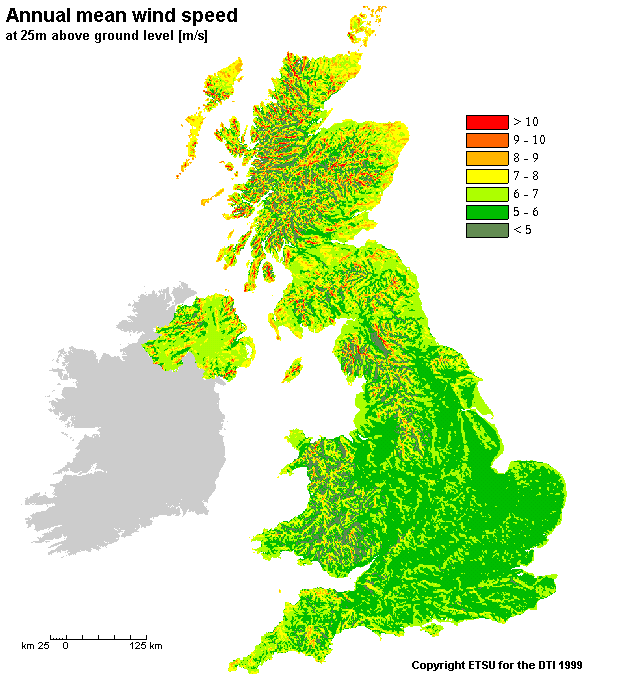
However, the rated power of the typical wind turbine (I picked the Futurenergy 1kW system at random) is based on wind speed of 12.5 m/sec... in other words, a force 6 "strong breeze". In fact, there are very few locations that have an average wind speed this high... see wind speed map of the UK - most of the country is below 6 m/sec - and this map is for wind speed at 25 metres above ground (a domestic turbine would be 5-10).


So for typical wind speeds expect much less power than it says on the tin. The main chart is derived from the better generation (an excellent site about practical green energy) and shows the approximate cubic relationship between wind speed and power output, but based on real measurements for real micro wind turbines - I've added the manufacturer's rated power and wind speed and power for my location to it. You can see a 90% fall in performance - I get about 100 watts for every rated kilowatt. But the cost doesn't change. So if I slip on the energy-numbers anorak, I calculate that a 1kW system costing just under £2,000 fully installed, would produce electricity at 22p/kWh and save carbon emissions at a cost of €450 per tonne of CO2 - more than 40 times the cost of the EU Emissions Trading System. The economics are very poor (though not as bad as for solar PV). See all data on this spreadsheet [XLS version].

Other issues arise from attaching a moving structure to your house: the advice is 'don't'. These things need to be mounted on a pole or the noise and vibration will drive you mad, and a stiff wind might damage your house.

Aren't people just trying to make a difference?
Some will object that people just want to make a green gesture - but I think people should be told when they are doing things that are terrible value for money and encouraged to spend it well, which usually means energy saving. Otherwise, there is a risk of a breach of trust and descent into cynicism about personal action and investment in the environment.

What about large wind turbines?
Large wind turbines are much better value for money, though of course with impacts of their own. They are placed in high wind-speed sites, high above the ground, and their blades have large swept area - the power output is proportional to the square of the rotor diameter as well as cube of wind speed. This is why large wind turbines have important economies of scale and why they are leading the rise of renewables.

... continues. Read full post.